It took me 2 years toupdate my portfolio
- Published
- Episode
- #76
- Length
No guest this time. My new portfolio site is finally out after more than two years, so I talk about why your own site is so hard to finish, the decisions behind mine, and why I built it with Astro and Claude Code.
My new portfolio site at janneparri.com is finally out. It took me over two years to publish it. Instead of interviewing a guest, I spent the week before this episode finishing the site. This is not a tour of how great it is. It is about why your own site is so hard to get out, the decisions behind mine, and why I built it with Astro and Claude Code instead of Webflow.
Why is your own site so hard to finish?
I wasn’t building the site every day for two years. I procrastinated on decisions and changed my mind on several things. I also changed the platform. I started the site in Webflow about a year ago, and at some point decided to try AI instead.
The first reason is the cobbler’s children effect. Client work always comes first, because it pays the bills. Your own project gets the evenings, the weekends and a few minutes here and there. Agency owners can tell their team to spend time on the agency’s own site. In theory freelancers can do the same, but in practice it is not that simple.
The second reason is that you know too much. If you build websites for a living, you know all the effects you could use. Typography effects, 3D, colors, animations and videos. You cannot put all of them into one site, so you have to make deliberate decisions.
And those decisions are super hard when you are your own client.
With a corporate client, no single person owns the brand. There is usually more data and some direction too. With your own site, you have a hunch from your past clients. But they might not be the clients you want in the future, so you have to pick a lane.
Why there is no Webflow in the H1
The H1 on the new site says design-led websites and design systems for humans and AI. There is no Webflow in it, and that was a tough decision. I’m not sure the H1 will still be there in a year.
Have I done proper design systems for clients in this AI age? Not really. But I want to, so that is why they are in the H1. I can still build Webflow sites, and Webflow is on the site. I’m just opening the door to more than websites.
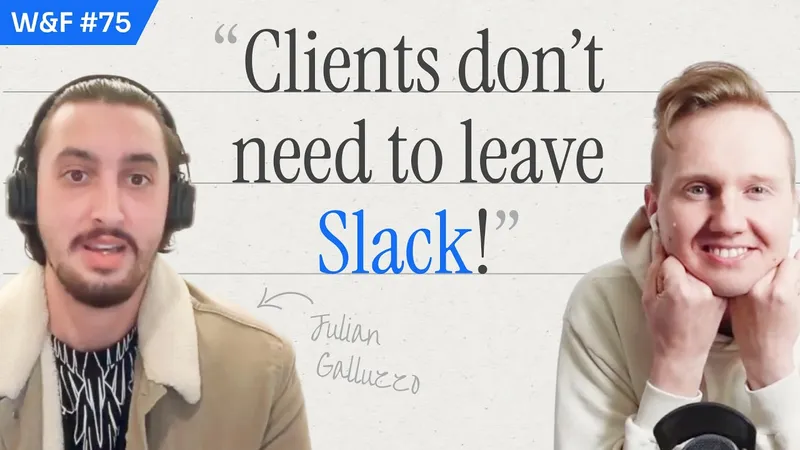
My talk with Julian Galluzzo in the previous episode opened my eyes. We have talked about development shrinking for a while now.
I truly feel like the whole website thing, including design of that website, that is also shrinking.
As Julian said, if you only build the site, you are a line item on the client’s to-do list. A retainer brings recurring revenue, but I don’t think clients really want one.
I have a feeling that no client really wants to have a website guy on a retainer. That is just a band-aid that they are forced to have because they are not able, or they do not have the time, to edit their own site.
Julian’s agency Native has a Slack agent that does the website edits for its clients. The client tags the agent in Slack and gets a preview link. Then someone with admin rights approves the change. I think that will become the standard way to edit websites. When it does, a retainer for website edits loses its value.
So I’m turning towards AI enablement. It is a weird term, but we need some term for it. There is a lot that technical people who are not full-blown developers can still give clients.
Why I went with my own name
I had to decide whether to keep using my own name or create a studio brand. I went with my own name. A studio brand makes sense if you want to grow an agency beyond yourself, scale and hire people.
A personal brand is easier to trust. You put your face on the line, so you have to do good work. It is also easier to relate to. I don’t feel like following generic brands, even when the algorithm shows me their content and I like it. I value personal brands and real human opinions.
Now that AI content is flooding the social media, I feel like that’s almost the only way to go.
Built with Astro and Claude Code, not Webflow
The new site is an Astro site, built almost only by prompting Claude Code. I had my Webflow project as a starting point and did proofs of concept in Webflow first. Then I decided to make this my first Astro build. My first Webflow project was my own site too, so it felt fitting.
There was no starter template. No Lumos, no GSAP and no CMS. It is all HTML, CSS and JS from Claude. Is that how I would build a site for a client? Probably not, except maybe a tiny one.
Prompting for all the little changes, that was quite frustrating.
At some points I really missed the Webflow editor. Next I’m trying Lumos for Astro and Ship Studio, and Source by Webflow when it comes out. There is definitely a place for a UI for us builders.
The technical results are good. The site loads fast, and I probably couldn’t have reached that performance with Webflow. Lighthouse gives it full marks, with a couple of points off on mobile, even with several videos on the page. There is no Google Analytics and no cookie pop-up. Cloudflare hosts the site, and I use its light analytics tool for a few numbers.
One question is still open. I have always been in the camp that the client owns all the accounts and all the code. For smaller clients, do I want to set up all those accounts and get guest access to each one?
Your own site can be the bottleneck
Your own portfolio site is valuable, and you have to be your own client to get it out.
I feel like my site was a bottleneck for so long.
If I had updated it earlier, who knows what clients I would have gotten. As a business grows, the bottlenecks move, even when the growth is in quality and not revenue. At some point the bottleneck is your own site. It doesn’t need to be perfect, and it never will be. It is for the next level.
You probably tell your clients that when their website is in order, everything else gets easier.
So why don’t you take your own advice?
Links from the episode
- #75 Most clients don’t want a visual builder
- #68 Webflow moved on. Did we?
- Julian Galluzzo on Webflow and Friends (opens in a new tab)
- Native (opens in a new tab)
- Timothy Ricks (Lumos) (opens in a new tab)
- Astro (opens in a new tab)
- Claude Code (opens in a new tab)
- Ship Studio (opens in a new tab)
- Source by Webflow (opens in a new tab)
- Cloudflare Web Analytics (opens in a new tab)
- My Finnish site
Full transcript
Read the full transcript
Janne Parri: It took me over two years to get my own personal portfolio site published. Let's talk about that. Hi guys, my name is Janne. You're listening to Webflow and Friends Podcast. And yes, this is a solo episode. Instead of prepping and interviewing a guest, I spent last week finalizing my personal portfolio site. And yes, it is finally out. This is not an episode where I gloat and tell how awesome the site is. This is me mainly reflecting on why is it so hard to get your own stuff out, and why did it take me so long to do that?
Janne Parri: I will also go through all sorts of decisions I had to make, some invisible stuff that affected my workflow and the design. And yeah, the site is not done with Webflow. So that's something new. I know doing one's own portfolio is a common challenge, and I'm hopeful that this episode will bring you some hope, maybe motivation to get your site out if it's not already. Well, in my experience, it takes just a couple of months after a site publish when you start thinking of the next refresh, redesign.
Janne Parri: Okay. I'm quickly going to show my site because some of you might be interested in that. For audio listeners, I will describe that. If you are not interested, just press a couple times that skip button that you know is there. It shouldn't take more than a minute to go through this.
Janne Parri: So here it is, janneparri.com. The link is in the description. And yeah, for the audio listeners, there's a big video of me waving around. The H1 says design-led websites and design systems for humans and AI. The background is this paper-like texture, and there's like strict columns. You might have seen the column grid effect on other pages, but I do not have those column caps, so that's different.
Janne Parri: And the effect, if you may, is that you can actually edit the column width. You can pick the golden ratio, clear thirds or this chaos column option, and the content will change according to your preferences. There's some audio effects, obviously a dark mode and light mode and so on, some accessibility things and so on.
Janne Parri: Content-wise, the work section with all sorts of hover animations, services and features, a little bit about me and so on. These sections are quite straightforward, no big effects on those. But yeah, overall I'm happy how this turned out. Do I think this is perfect? No. As you know, you can never be satisfied. But yeah, if you want to leave comments, you can leave them in the comments, obviously, or just DM me if you wish. But yeah, check it out.
Janne Parri: You might have noticed that there is no Webflow word in the H1. And as I said, this site has not been done with Webflow. So I will talk more about that later. And if you're wondering why did it take so long, like over two years, obviously I wasn't building this site deliberately every day throughout that two years.
Janne Parri: It was me procrastinating on decisions, changing my mind on several things, actually changing the platform too. I started on Webflow probably a year ago, and then at some point decided that let's have a try with AI. And that is actually what you are seeing right now. But yeah, let's talk about why updating one's own site is always so hard and time-consuming.
Janne Parri: I strongly believe there is a cobbler's children do not have shoes effect going on. By the way, that saying works also in Finnish. And yeah, you know, client work always comes first. So especially for freelancers, when you're trying to update your site, like there's a big client. Or not even a big client, any client that asks for something, their work always comes first, obviously, because that pays the bills.
Janne Parri: And usually your own project gets those off hours, maybe the weekends, maybe evening hours, or a couple of minutes here and there. And that is just not the best way to work. It would be optimal if you could allocate several hours of deliberate focused work for your project. But that is simply not the way it goes.
Janne Parri: When I have talked with all sorts of agency owners and freelancers, I get the feeling that the challenge is similar for both. But the agency owners obviously have the possibility to just say to their workers that okay, you have to allocate some time for our own site. So that's kind of an easier thing to do. In theory freelancers can do the same thing, but in practice it is not that simple.
Janne Parri: The second thing is if you do this for a living, or if you build websites for a living, you know all the fancy things you could do with the site, all the effects. And you probably know that you simply cannot put all of those into one site. If you want to do fancy typography effects, 3D, all sorts of colors and animations and videos, that will just end up being a mess. It's kind of like in colors, like you know all those cool colors, but you simply cannot put all of those into one design.
Janne Parri: So you have to do deliberate decisions. And those decisions are super hard when you are your own client. You always question your decisions and you wonder if something else would be better. I'm not sure if there is some rockstar designer who is super confident with their decisions, especially when it comes to their own stuff. But I know that at least I'm not that confident.
Janne Parri: And this kind of trickles down to all the discovery work. When we do designs for clients, we want to go through all the stakeholders, all the target audiences and the target image you want to reflect with the design. But when you're trying to communicate yourself, your personal brand out there, it is simply hard.
Janne Parri: You know that you have to be concise, you have to have clear brand, you have to clearly communicate what you are doing and for who, and that all should flow through the copy, the visual things, and all that you do. But even if you are able to do a coherent entity, there needs to be the decisions that make that. Who am I doing my services for, and who is the target audience? What should I write on that H1? And those are the tough questions that you have to eventually do.
Janne Parri: I feel like if you have a corporate client or a bigger company, it's easier to do those decisions, because no single person owns that brand personally and you usually have more data and some sort of direction. But when you're doing it for yourself, you have a hunch of your past clients, but those past clients might not be the ones that you want to have in the future. So you kind of have to predict the future, or pick a lane, pick a direction where you want to go.
Janne Parri: And that kind of brings us to the AI. Like, who knows what the future will bring us? With my site, I try to separate the visual side and the copy side. With the visual side, I try to communicate like blank canvas, hence the paper texture. Pixel-perfect execution, hence the column lines. And customization, the variable columns and content.
Janne Parri: And I feel that that holds quite well even if my services vary a bit. But to be honest, the H1 is always where it comes down. I do not have Webflow in there. So that was a tough, tough decision. I'm not sure if that H1 will be there in a year or so. Have I done proper design systems for my clients? Not really, not in this AI age, but I want to do those, so that's why it is there. I can still do Webflow sites if I want. Webflow is kind of present on the site, but as I said, I'm opening the doors to do more than just websites.
Janne Parri: And to be honest, my talk with Julian, it was probably the last episode I did, that really opened my eyes, in a way that we have been talking about development shrinking. But I truly feel like the whole website thing, including design of that website, that is also shrinking. Like if you are so-called website guy or girl, I have a feeling that the amount of time and budget people are allocating for that specific part, if we talk about the build part of the site, that is kind of shrinking too.
Janne Parri: Maybe not for everybody, but there is pressure to do more. As Julian said, if you do just that, you are just a box to be ticked, like a line item on their to-do list. And yes, you might sell a retainer and have some recurring revenue there. But to be honest, I have a feeling that no client really wants to have a website guy on a retainer. That is just a band-aid that they are forced to have because they are not able, or they do not have the time, to edit their own site.
Janne Parri: I'm not saying that retainers are bad. And many clients would love to have a person who handles all the things for them. But I would imagine that they would love even more if you could do more than just those website changes.
Janne Parri: And talking about those website changes, Julian talked about their Slack agents. Native agency has this Slack agent which does all the website edits for the client. So in Slack they will tag the agent and it will do the change, give a preview link, and the person with admin rights will approve that and that gets published. That sounds to me like a great user experience. And that is possible today, and I would imagine that inevitably that will become the standard for editing the websites.
Janne Parri: And when that happens, what happens to your retainers? What is the value that the retainer has? As I said, you have to do more than just website edits, which brings us to the whole AI enablement part. That's a term that says it all, says nothing. It's a weird, weird term, but yeah, we have to have some sort of term for it. But I am turning towards that.
Janne Parri: There is so much value that we as technical people who are not full-blown developers can still give to the clients. Obviously there are other routes, like doubling down on design and strategic design and the marketing stuff, but even those have a lot of AI in them. So it might not be either or, it might be both and.
Janne Parri: Okay, so the whole AI thing came into the picture while I was redesigning my site, so it has a lot to do with the copy, the services, but there were other things too. I already talked about the visual side. I wanted to have an uplift. My old site, it was nice, it was good, it did the thing. And I also have my Finnish site, more on that later. But I was aiming for more premium feel.
Janne Parri: And one decision I had to make is if I want to continue using my own name or create some sort of studio brand. And obviously I went with my own name. I'm doubling down on my personal brand. I see many people doing the studio thing and that is all well and good, especially if you want to grow the thing, maybe an agency outside of yourself, you want to scale that, hire people and so on. That is easier to do with a separate brand.
Janne Parri: But the personal brand, I feel like it's easier to build trust. You are the one guy you say you are, and you put your face on the line, so you kind of have to do good work, or else you are like mudding your own brand. And there's no way out of that. And also it's easier to be relatable.
Janne Parri: Especially in the content creation world, I feel like personal brands are becoming even more valuable. I do not feel like I want to follow any generic brands. Even if the algorithm feeds me their content and I like it, I do not feel like I want to follow them. But personal brands and actual human opinions, I value them quite highly. Now that AI content is flooding the social media, I feel like that's almost the only way to go.
Janne Parri: Okay, I will go through the technical stuff and decisions now, and then I will have the hidden factors, the history, kind of like the technical debts I had when going into this. But yeah, the technical stuff. It is an Astro site, and it has been built almost solely by using Claude Code. So no terminal, no Ship Studio, no nothing. I basically prompted my way from the initial build to the details and corrections.
Janne Parri: I did have the Webflow project as a starting point. I'm not sure how much of that still lives in the code. But yeah, I did do those things and proofs of concept in Webflow, but at some point I decided that I will try to do this as an Astro build, just to get my first Astro build done. That was my way into Webflow way back. I did my own site. I believe I had some sort of WordPress site at some point, but I did my personal site in Webflow, and that was my first Webflow project. So it was just fitting to do the same with this static Astro site.
Janne Parri: But yeah, there was no starter template. I did not use Lumos. There is no GSAP, there is no CMS. It's all HTML, CSS and JS from Claude. Is that the best way to do it? Probably not. Is that the way I would do it for a client? No, probably not. Maybe for a tiny, tiny site, but there could definitely be improvements for that workflow.
Janne Parri: I have been checking out Lumos for Astro and comparing that with Tailwind. So Lumos looks promising. I actually created a test project, it was probably yesterday. I will be trying that out. Also Ship Studio, I want to give that a proper go and see how that differs. Prompting for all the little changes, that was quite frustrating. And yeah, it is not the best way to handle those things.
Janne Parri: At some point I did really miss the Webflow editor, and that's why I am trying out Ship Studio next. When Source comes out, I will definitely try that too, maybe even open this page in Source and see what it can do. I don't know, I might need to try it out with something smaller, some test project before that. But yeah, there's definitely a place for some sort of interface, some sort of UI for us builders.
Janne Parri: And am I happy with the results, especially the technical results? Yeah. I got to say it loads fast. The performance is something I probably couldn't have reached with Webflow. It's full hundreds on Lighthouse, maybe a couple points off on the mobile Lighthouse, and I have several videos on the first site. So yeah, it is working beautifully.
Janne Parri: One little detail, I do not have Google Analytics there and no cookie pop-ups. I hate those things. But I do have Cloudflare. Cloudflare is the hosting provider that I chose, and they have this light little, I believe server-side, analytics tool. So I'm using that to get some sort of numbers out of there. But yeah, I'm not going to do huge conversion optimization stuff with the site, so just a couple of numbers are just fine for me.
Janne Parri: Still reflecting on the Astro site thing, there is a lot to stitch. I believe after a couple of projects, you will have a boilerplate that you just copy, you have all sorts of decisions made already, so it will get easier. The one thing I'm thinking, could this work for smaller clients? I have always been in the camp that the client owns all the accounts and all the code. That is definitely still possible. But for smaller clients, do I want to be setting up all of these accounts and guest access for me to those accounts? That's a big question mark that I still have.
Janne Parri: If you have found your way this far into the episode, kudos to you. Thanks so much for listening. It's not going to end yet. I have some hidden factors, or kind of history, that played a part in this whole redesign and actually will play a part going towards the future. You might know that I have been working for Finnish clients, and I have a Finnish site, a separate Finnish site, and that has been my lead source.
Janne Parri: It did good when Webflow was a newer thing in the search results, and I still get inquiries from that. And I still get quite a lot of impressions, a little bit less clicks, but impressions in Google and AI Overviews through that site. And the site that I have been talking about this whole episode, that's my English site, janneparri.com. The Finnish site is .fi. And the thing with the Finnish site is that it's now the outdated one of the bunch. But it has over fifty pages.
Janne Parri: So there's all sorts of landing pages, all sorts of CMS collections. And I do not have a plan, a clear plan, how will I update that, or will I update that, or should I just have it under the .com? Yeah, the big part is obviously the visibility that it gets and the authority that it has.
Janne Parri: My general plan, which I wish will become even more clear in the future, the hope is that my new site, the English site, will produce some leads, will get noticed. I am directing clients, all my social medias and so on to that site because it is simply better visually, and I'm hopeful that it will get traction, and at some point I can retire the Finnish site, or maybe do a redirect or something like that.
Janne Parri: But there is a clear mismatch with the target audiences. The English site is geared towards premium clients or bigger clients, and the Finnish site is more towards smaller clients, or at least those are the leads that are coming in. Obviously, if I get a lot of traction in Finnish SEO results, there are all sorts of people, all sorts of companies searching for websites, and the number of big companies are just smaller by probability.
Janne Parri: So even if I don't get that many leads from the new site, if they are better leads and they can sustain my business, then I would probably retire the old site completely. Because the thing is that Finnish clients, especially the bigger companies, they are just fine reading English things. The only thing that they want to know is that I also speak Finnish.
Janne Parri: But there is also this one idea I have been circling around. If one could actually do sites semi-automatically, then it would change the game for low budget, high volume sites. Like if I could do a separate brand for the Finnish market that would spin out AI-generated sites, and do that in volume. That is obviously a totally different game, but that is an idea that has been stuck in my brain.
Janne Parri: So I might do that. I'm not sure when I have the time, but that is something I could do. But that would probably be firstly just for a Finnish audience. The problem is not the amount of ideas, it is the execution, as always.
Janne Parri: Okay, I have been yapping for a while now. Thanks again if you have listened this far. Next week I will have a proper guest, and you do not have to listen to me. But just as an ending thought, your own portfolio site is obviously super valuable. You have to be your own client. You have to get that out.
Janne Parri: I feel like my site was a bottleneck for so long. If I would have been able to update the site earlier, who knows what kind of clients I would have gotten. When your business grows, and that might not even mean revenue, just quality, you can see that there are all sorts of bottlenecks. And at some point the bottleneck might be your own site, your own portfolio. And the sooner you get that done, the better. Then you can go and fix the next issue.
Janne Parri: Does the site need to be perfect? No, it will never be perfect. It is just for the next level. And who knows what tomorrow brings. You might need to do that again, or you might need to fix something totally different. But you probably also say to your clients that when you have your website in order, everything else becomes easier. So why don't you take your own advice? Okay, that's all. No Finnish Line today. Have a nice one, and I'll see you in the next one. Bye.
About Webflow and Friends
A podcast about building websites with Webflow and the tools around it. Janne Parri talks with designers, developers and marketers about how they design, build and run sites for fast-moving teams.
Hosted by Janne Parri. Janne designs and builds design-led websites and design systems for fast-moving marketing teams, in Webflow or Astro, and is a Webflow Certified Partner.